
1. Sarrera
Eskerrik asko erosketagatik.asing the JAPANNEXT JN-IPS321UHD 32-inch 4K UHD IPS Monitor. This monitor is designed to provide a high-quality visual experience with its 3840x2160 resolution, wide viewing angles, and HDR support. This manual will guide you through the setup, operation, maintenance, and troubleshooting of your new monitor to ensure optimal performance and longevity.
2. Segurtasun informazioa
Please read and follow these safety guidelines carefully before using the monitor:
- Ez jarri monitoreari euriari, hezetasunari edo muturreko tenperaturei.
- Ziurtatu aireztapen egokia monitorearen inguruan, gehiegi berotu ez dadin.
- Erabili monitorearekin batera datorren korronte-egokitzailea soilik.
- Ez jarri objektu astunak korronte-kablean.
- Ez saiatu monitoreak zeuk desmuntatzen edo konpontzen. Mantendu konponketa guztiak langile kualifikatuen esku.
- Garbitu pantaila zapi leun eta lihorik gabeko batekin. Saihestu produktu kimiko gogorrak erabiltzea.
3. Paketearen edukia
Egiaztatu elementu guztiak paketean daudela:
- JAPANNEXT JN-IPS321UHD Monitor
- Monitore Stand
- HDMI kablea
- DisplayPort kablea
- Elikatze-kablea
- Elikatze-moldagailua
- Erabiltzailearen eskuliburua
- Berme Txartela
- Urruneko kontrola (pilak ez barne)
4. Konfigurazioa
4.1 Standa lotzea
Carefully place the monitor face down on a soft, clean surface to prevent scratches. Attach the stand base to the stand neck, then secure the assembled stand to the back of the monitor using the provided screws.
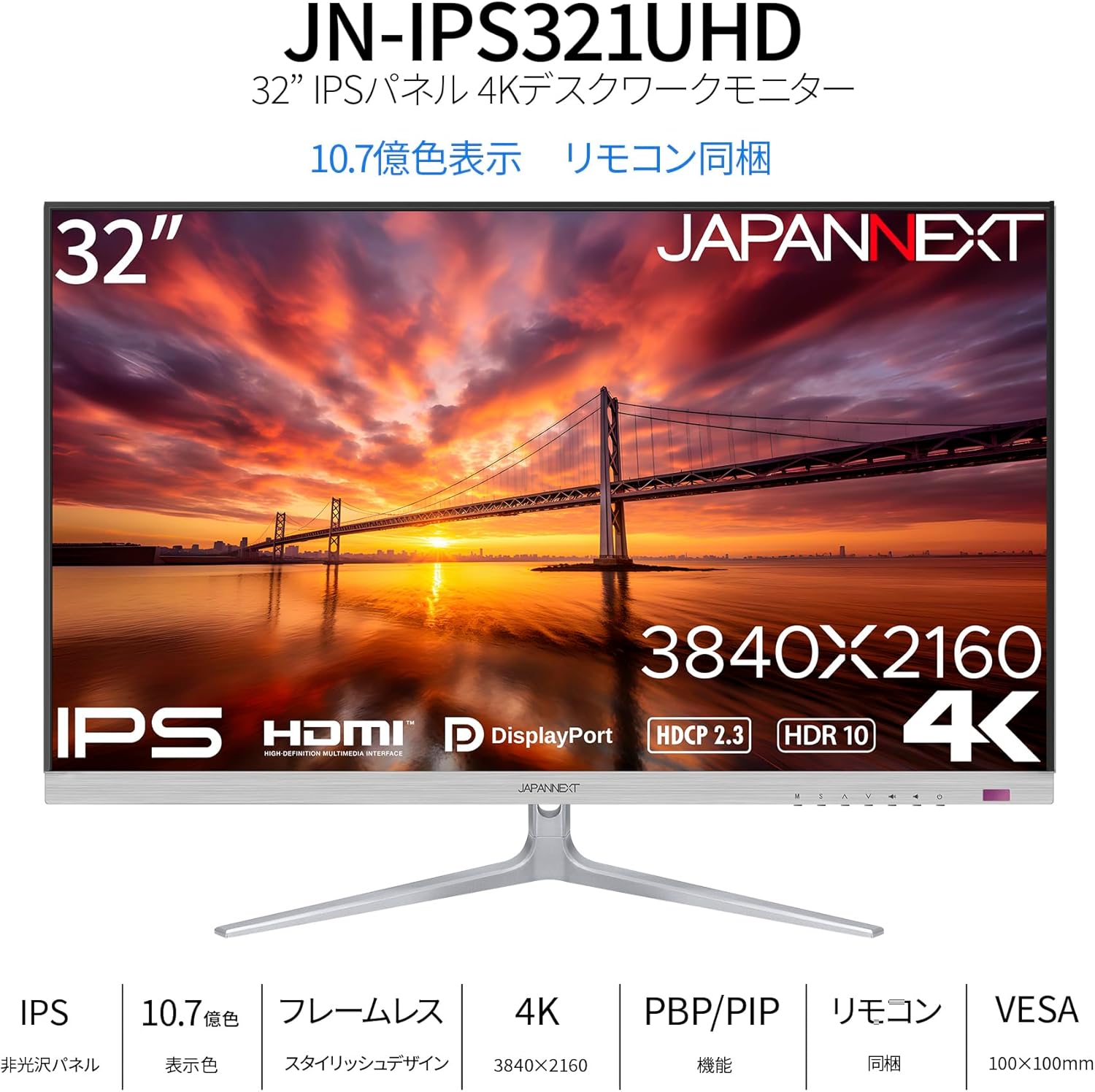
Irudia: Aurrealdea view of the monitor with its attached stand.
4.2 VESA euskarriaren instalazioa (aukerakoa)
The monitor supports a 100x100mm VESA mount. If you prefer to mount the monitor on a wall or an alternative stand, remove the factory stand and attach your VESA-compatible mounting bracket. Ensure the mounting screws are of appropriate length to avoid damaging internal components.

Irudia: Atzealdea view of the monitor, highlighting the VESA mount area and input ports.
4.3 Konektatzeko kableak
Connect the power adapter to the monitor's power port and then to a power outlet. Connect your video source (PC, game console, etc.) to one of the available input ports (HDMI or DisplayPort) on the monitor. If desired, connect external speakers or headphones to the audio output port.
Image: Close-up of the monitor's input panel, showing Audio Out, DisplayPort 1.4 (x2), HDMI 2.1 (x2), and Power Port.
5. Monitorea funtzionatzea
5.1 Piztu/Itzali
Press the power button on the monitor or the remote control to turn the monitor on or off. The power indicator light will show the monitor's status (e.g., blue for on, amber for standby).
5.2 Sarrera hautatzea
Use the input selection button on the monitor or the remote control to cycle through the available input sources (HDMI 1, HDMI 2, DisplayPort 1, DisplayPort 2). The monitor will automatically detect an active signal.
5.3 Pantailan bistaratzeko (OSD) menua
Access the OSD menu using the buttons on the monitor or the remote control to adjust various settings such as brightness, contrast, color temperature, and picture modes. Navigate through the menu using the directional buttons and confirm selections with the OK/Enter button.
5.4 Picture-by-Picture (PBP) and Picture-in-Picture (PIP)
The monitor supports PBP and PIP functions, allowing you to display content from multiple input sources simultaneously. Refer to the OSD menu for options to configure these modes, including layout and source selection. PBP mode can display up to two input images side-by-side, while PIP mode displays one input as a smaller window over another main input.
5.5 Joko modua
The monitor features a dedicated Game Mode to optimize visual settings for gaming. This mode can enhance visibility in dark areas and improve response times. Activate and configure Game Mode through the OSD menu.

Image: Monitor screen showing a game with the 'Picture Mode' menu, including FPS and Game options.
5.6 Audio Ezaugarriak
The monitor includes built-in 2W x 2 stereo speakers for audio output. You can adjust the volume through the OSD menu or the remote control. For higher quality audio, connect external speakers or headphones to the audio output port.

Image: Monitor displaying a music scene, illustrating the integrated speakers.
5.7 HDR euskarria
The monitor supports High Dynamic Range (HDR) content, providing a wider range of colors and contrast for a more immersive viewing experience. Ensure your connected device and content also support HDR for this feature to function.
5.8 Blue Light Reduction
To reduce eye strain during prolonged use, the monitor features a blue light reduction mode. This setting can be adjusted or enabled/disabled via the OSD menu.
6. Mantentzea
6.1 Monitorea garbitzea
Before cleaning, ensure the monitor is turned off and unplugged from the power outlet. Use a soft, dry, lint-free cloth to gently wipe the screen and exterior surfaces. For stubborn marks, lightly dampen the cloth with water. Avoid using alcohol, ammonia, or abrasive cleaners, as these can damage the screen or finish.
6.2 Arreta orokorra
Keep the monitor away from direct sunlight, heat sources, and areas with high humidity. Do not block the ventilation openings. When moving the monitor, handle it carefully to avoid impact or damage.
7. Arazoak
Monitorearekin arazoak badituzu, jo ezazu honako arazo eta irtenbide ohikoenei:
- Potentziarik gabe: Ziurtatu kablea ondo konektatuta dagoela monitoreari eta entxufeari. Egiaztatu ea kable-egokitzailea behar bezala funtzionatzen duen.
- Seinalerik ez: Verify that the video cable (HDMI or DisplayPort) is properly connected to both the monitor and your source device. Ensure the correct input source is selected on the monitor.
- Irudi keinukaria edo distortsionatua: Check the video cable for damage. Try a different cable or input port. Ensure your source device's display resolution and refresh rate are compatible with the monitor's specifications.
- Ez dago soinurik bozgorailuetatik: Check the volume settings on both the monitor and your source device. Ensure the audio cable (if used) is properly connected.
- Urruneko kontrola ez dabil: Check the batteries in the remote control. Ensure there are no obstructions between the remote and the monitor's IR receiver.
Urrats hauek probatu ondoren arazoa konpontzen ez bada, jarri harremanetan bezeroarentzako arreta-zerbitzuarekin.
8. Zehaztapenak
Below are the detailed technical specifications for the JAPANNEXT JN-IPS321UHD monitor:

Image: Detailed specifications table for the monitor.
| Ezaugarri | Zehaztapena |
|---|---|
| Modelo zenbakia | JN-IPS321UHD |
| Pantailaren tamaina | 32 hazbetekoa |
| Panel mota | IPS (AHVA) |
| Ebazpena | 3840 x 2160 (4K UHD) |
| Aspektu-erlazioa | 16:9 |
| Freskatze tasa | 60Hz |
| Erantzun Denbora | 12ms (Gehienez) |
| Distira | 300 cd/m² |
| Kontraste-erlazioa | 1000:1 |
| Viewangelua | H: 178 ° V: 178 ° |
| Koloreen euskarria | 1.07 billion colors, sRGB:96% |
| HDR euskarria | HDR10 |
| HDCP euskarria | HDCP 2.3 |
| Sarrerak | HDMI 2.1 x2 (60Hz), DisplayPort 1.4 x2 (60Hz) |
| Audio Irteera | Bai |
| Hizlariak | 2W x 2 |
| VESA mendia | 100x100mm |
| Neurriak (euskarriarekin) | 725 mm x 505 mm x 207 mm |
| Neurriak (euskarririk gabe) | 725 mm x 432 mm x 51 mm |
| Pisua (produktua) | 8.9 kg |
| Energia-kontsumoa | 47W (typical), 1W (standby) |
9. Bermea eta Laguntza
Your JAPANNEXT JN-IPS321UHD monitor comes with a warranty. Please refer to the included warranty card for detailed terms and conditions, including the warranty period and coverage. Keep your proof of purchase for warranty claims.
For technical assistance, troubleshooting beyond this manual, or warranty inquiries, please contact JAPANNEXT customer support. Contact information can typically be found on the official JAPANNEXT webgunean edo produktuarekin batera emandako berme-txartelean.