1. Sarrera
The Waveshare ESP32-S3 Dual Eye Round LCD AIoT Development Board is a versatile microcontroller development platform designed for makers and electronics enthusiasts. Based on the ESP32-S3 chip, it offers robust connectivity with 2.4GHz Wi-Fi and Bluetooth BLE 5. This board features dual 1.28-inch round IPS LCD displays, each with 240x240 resolution and 65K colors, capable of running graphical user interfaces (GUIs) like LVGL smoothly. It also integrates a microphone, speaker header, Lithium battery recharge circuit, TF card slot, and various expansion connectors, making it suitable for a wide range of applications including HMI, robotic agents, and AI voice-interactive projects.

1.1. irudia: The Waveshare ESP32-S3 Dual Eye Round LCD AIoT Development Board. This image shows the compact design of the board with its two circular displays, one of which is being touched by a finger, illustrating its interactive capabilities.
2. Ezaugarri nagusiak
- Prozesadorea: High-performance Xtensa 32-bit LX7 dual-core processor, up to 240MHz main frequency.
- Haririk gabeko konektagarritasuna: 2.4 GHz-ko Wi-Fi (802.11 b/g/n) eta Bluetooth 5 (LE) onartzen ditu barneko antena batekin.
- Memoria: 512KB-ko SRAM eta 384KB-ko ROM integratuak, 8MB-ko PSRAM eta 16MB-ko Flash barnearekin.
- Pantailak: Dual 1.28-inch LCD displays, 240 × 240 resolution, 65K color, with optional capacitive touch function.
- Audioa: Onboard ES8311 audio codec and ES7210 audio ADC chip, equipped with a standard microphone and speaker header, supporting AI speech interaction.
- Biltegiratzea: Onboard TF card slot for convenient local storage expansion of data, images, and audio files.
- Energia kudeaketa: Onboard Lithium battery recharge management module, with a reserved 3.7V Lithium battery power supply header.
- Hedapena: Onboard SH1.0 14PIN connector, adapting UART, I2C, and various IO interfaces for DIY customization.
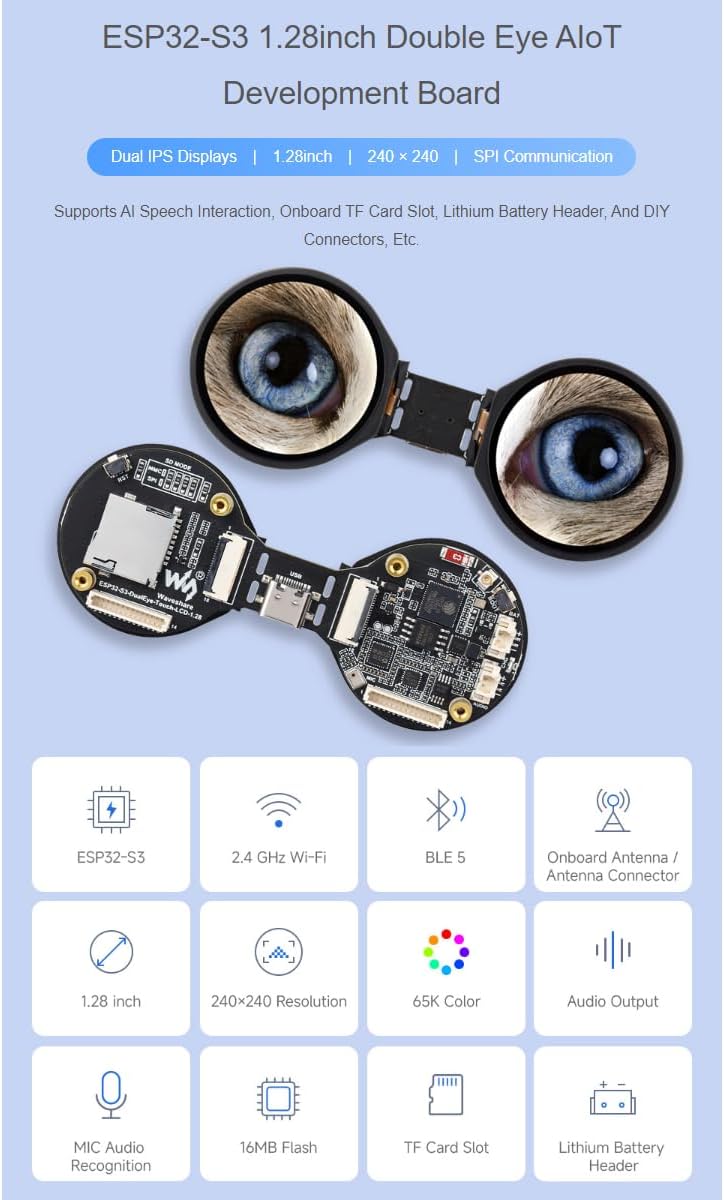
2.1. irudia: Eginbidea amaitu daview of the ESP32-S3 Dual Eye AIoT Development Board. This image displays the board along with various icons representing its core functionalities such as ESP32-S3 chip, Wi-Fi, Bluetooth, onboard antenna, 1.28-inch displays, 240x240 resolution, 65K colors, audio output, MIC audio recognition, 16MB Flash, TF card slot, and Lithium battery header.
3. Paketearen edukia
Zure paketean elementu hauek sartzen dira:
- ESP32-S3-DualEye-Touch-LCD-1.28 Board x1
- SH1.0 14PIN cable (~100mm) x1
- FFC 18PIN cable (~200mm) x1
- 8Ω 2W MX1.25 2PIN bozgorailua x1

3.1. irudia: Package contents. This image shows the ESP32-S3 Dual Eye Touch LCD board, an FFC cable, a SH1.0 14PIN cable, and an 8Ω 2W MX1.25 2PIN speaker, which are all included in the product package.
4. Konfigurazioa eta hardwarea amaitutaview
Before operating the board, familiarize yourself with its components and connection points.
4.1. irudia: What's On Board. This diagram provides a numbered overview of the ESP32-S3 Dual Eye Touch LCD board's components and connectors, essential for setup and development.
4.1 Osagaien identifikazioa
- ESP32-S3R8: Dual-core processor, up to 240MHz operating frequency.
- 16MB Flash.
- Battery recharge management chip.
- Amplifier chip.
- ES8311: Audio codec.
- ES7210: Audio ADC.
- Mikrofonoa.
- MP1605GTF-Z: Power module, supports up to 3.3V 2A output.
- Onboard ceramic antenna.
- IPEX1 connector: For connecting an external antenna, enabled via resoldering an onboard resistor.
- BOOT botoia.
- GPIO1 function selection resistor: Soldered on the side near the crystal by default; the GPIO1 pin is used for battery voltage measurement. Resoldered to the other side: the GPIO1 connects to the 17. FPC connector, enabling three-screen display function through software modification.
- Battery header.
- MX1.25 2PIN connector for 3.7V Lithium battery, supports charging and discharging.
- Charge indicator: Lithium battery charge indicator, lights up when charging, off when fully charged (the light status is uncertain when the battery is not connected).
- Speaker header.
- SH1.0 14PIN header.
- 18PIN FPC connector: For three-screen display function by resoldering the 12. resistor and modifying the display configuration parameters in the program. When the board is split into two halves, this FPC connector can be linked with 18. FPC connector so that both displays function properly (Note: when the board is split and connected via FPC cable, the RESET button will be unavailable).
- 18PIN FPC header: For connection to the host.
- TF card communication mode selection: When the board is split into two halves, switching to SPI mode allows the TF card to be controlled by an external master controller.
- TF txartelaren zirrikitua.
- RESET botoia.
- SH1.0 14PIN cable header: For controlling TF card and the LCD display via SPI interface when the board is split into two halves and resoldering 19. resistor to SPI mode.
- C motako ataka.
4.2 Hasierako konexioa
- Elikatze-iturria: Connect the board to a power source using the Type-C port (24). Alternatively, connect a 3.7V Lithium battery to the Battery header (13) or MX1.25 2PIN connector (14).
- Bozgorailuaren konexioa: If using the included speaker, connect it to the Speaker header (16).
- TF txartela: Insert a TF card into the TF card slot (21) for local storage if needed.
- Hedapena: Utilize the SH1.0 14PIN header (17) or other FPC connectors (18, 19) for custom expansions as required by your project.
5. Funtzionamendu-argibideak
5.1 Garapen-ingurunea
The ESP32-S3-DualEye-Touch-LCD-1.28 supports two primary development tools and frameworks:
- Arduino IDEa: A popular choice for ease of use and a large community.
- ESP-IDF: Espressif IoT Development Framework, offering more control and advanced features for complex projects.
Choose the development tool that best suits your project requirements and personal preferences. Development resources and examples can be obtained by contacting Waveshare support.
5.2 Display and Touch Functionality
The board features dual 1.28-inch IPS displays with 240x240 resolution. The displays support 65K colors and can render GUIs efficiently. The optional capacitive touch function is controlled via an I2C interface, providing flexible operation and smooth UI interaction with interrupt support.

5.1. irudia: Capacitive Touch. This image demonstrates the touch functionality of the displays, showing a finger interacting with one of the screens displaying a scenic image.
5.3 AI Speech Interaction
The integrated microphone and audio codec chips enable AI speech interaction. This allows the board to process audio input and interact with online large model platforms such as DeepSeek and Doubao for advanced speech recognition and response capabilities.

5.2. irudia: Supports AI Speech Interaction. This diagram illustrates the workflow of AI speech interaction: a conversation is made with the built-in microphone, sent to a large model platform for analysis, an answer is received, and a reply is generated via an external speaker.
5.4 Audio Input and Output
The onboard audio codec chip supports high-quality audio processing, providing clear audio input and output. This is crucial for applications involving sound, music, or voice commands.

5.3. irudia: Onboard Audio Codec Chip. This image visually represents the audio output and input capabilities of the board, with musical notes displayed on the screens, indicating sound processing.
6. Mantentzea
To ensure the longevity and optimal performance of your ESP32-S3 Dual Eye Round LCD AIoT Development Board, follow these maintenance guidelines:
- Manipulazioa: Always handle the board by its edges to avoid touching sensitive components or applying undue pressure to the displays.
- Garbiketa: Use a soft, dry, anti-static cloth to clean the board and displays. Avoid using liquids or abrasive materials.
- Biltegiratzea: Store the board in a cool, dry, and dust-free environment. If not in use for extended periods, consider storing it in an anti-static bag.
- Potentzia: Ziurtatu elikadura-hornidura egokiatage (3.7V for battery, 5V via Type-C) and avoid reverse polarity connections.
- Ingurumena: Protect the board from extreme temperatures, humidity, and direct sunlight.
7. Arazoak
If you encounter issues with your development board, consider the following troubleshooting steps:
- Potentziarik gabe:
- Egiaztatu C motako kablearen konexioa eta energia-iturria.
- If using a battery, ensure it is charged and correctly connected to the battery header.
- Verify the charge indicator LED (15) behavior.
- Pantaila ez dabil:
- Ensure FFC cables are securely connected.
- Check display initialization code in your program.
- If the board is split, ensure the 18PIN FPC connector (18) and resistor (12) are correctly configured.
- Wi-Fi/Bluetooth konexio arazoak:
- Verify your code for correct Wi-Fi/Bluetooth initialization and credentials.
- Ensure the onboard ceramic antenna (9) is not obstructed.
- If using an external antenna, ensure it's properly connected to the IPEX1 connector (10) and the onboard resistor is configured correctly.
- Audio arazoak:
- Check speaker connection to the Speaker header (16).
- Verify audio codec initialization and playback/recording code.
- Ensure the microphone (7) is not covered.
- TF Card Not Detected:
- Ensure the TF card is fully inserted into the TF card slot (21).
- Check TF card communication mode selection (20) if the board is split.
- Verify your code for correct TF card initialization and file sistemarako sarbidea.
For further assistance, refer to the official Waveshare documentation or contact their technical support.
8. Zehaztapenak
| Ezaugarri | Xehetasuna |
|---|---|
| Prozesadorea | Xtensa 32 biteko LX7 nukleo bikoitzekoa, 240 MHz-raino |
| Haririk gabeko konexioa | 2.4 GHz-ko Wi-Fia (802.11 b/g/n), Bluetooth 5 (LE) |
| Ontziko memoria | 512KB SRAM, 384KB ROM, 8MB PSRAM, 16MB Flash |
| Pantailak | Dual 1.28-inch IPS LCD, 240 × 240 resolution, 65K colors |
| Ukitu funtzioa | Optional Capacitive Touch (I2C interface) |
| Audioa | ES8311 Codec, ES7210 ADC, Microphone, Speaker Header |
| Biltegiratze-hedapena | TF txartelaren zirrikitua |
| Potentzia Sarrera | Type-C, 3.7V Lithium Battery Header |
| Neurriak | 4.25 x 3.15 x 1.02 hazbete (Paketea) |
| Elementuaren pisua | 0.704 ontza |
| Modelo zenbakia | ESP32-S3 Double Eye Touch LCD (ESP32-S3-DualEye-Touch-LCD-1.28) |
9. Bermea eta Laguntza
9.1 Bermearen informazioa
Specific warranty details for the Waveshare ESP32-S3 Dual Eye Round LCD AIoT Development Board are typically provided at the point of purchase or on the official Waveshare webgunea. Mesedez, kontsultatu erosketa-dokumentazioa edo fabrikatzailearena. website for the most accurate and up-to-date warranty policy.
9.2 Laguntza Teknikoa
For technical assistance, development resources, or inquiries regarding the ESP32-S3 Dual Eye Round LCD AIoT Development Board, please visit the official Waveshare support page or contact their customer service directly. You can often find detailed documentation, example code, and community forums on their webgunea.
Waveshare Ofiziala Webgunea: www.waveshare.com


